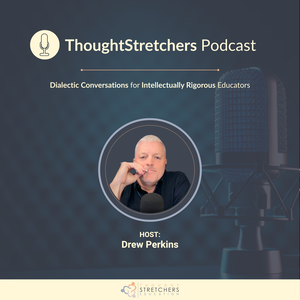
Drew Perkins talks with Mark Enser about his Substack piece titled, A Pedagogy for Powerful Knowledge | Why dialogue, enquiry and cognitive science aren't competing answers. This episode addresses questions like: "How to combine cognitive science with inquiry-based learning", "Differences between classroom discussion and dialogic teaching", "Why inquiry requires high-level scaffolding", and "How to avoid algorithmic teaching in the classroom".
The "Future Three" Pedagogical Model: Education should move away from abstract, student-led theories toward a "Future Three" approach that prioritizes objective knowledge transmission as the foundation for deeper inquiry.1 Synthesizing Pedagogy: Powerful knowledge is not achieved by picking one method; it requires a synergy of cognitive science (for stability), dialogic teaching (for deeper truth-seeking), and structured inquiry.
Dialogue vs. Discussion: Discussion is often superficial and biologically primary. True dialogue is a trained skill requiring support and Socratic guidance to help students critique models and search for truth.
Structuring Inquiry: Inquiry is not "minimal guidance." Effective inquiry must be highly scaffolded, using conceptual questions as "maps" that provide a clear purpose for the learning journey and guide students through the application of foundational knowledge.
Avoiding "Cargo Cult" Pedagogy: Teachers must prioritize intent over rote, algorithmic application of cognitive science. Methods like retrieval practice should require deeper cognitive effort rather than being used as a checklist of simple recall techniques.
Progression for Novices: While integrating all three pillars is the goal, cognitive science practices are often the most stable starting point for novice teachers, as they are easier to structure into playbooks and carry the least risk of unproductive outcomes.
Episode Highlights & Timecodes
[00:03:04] Mark Enser's Background: From 20 years as a geography teacher to an Ofsted inspector and freelance consultant.
[00:12:02] Pedagogical Evolution: The shift from a "Future Two" mindset (student-led) to a "Future Three" model (prioritizing objective knowledge).
[00:18:15] The Core Thesis: Why "powerful knowledge" requires a synergy of cognitive science, dialogic teaching, and structured inquiry.
[00:20:31] Discussion vs. Dialogue: Distinguishing between the social behavior of discussion and the trained, guided skill of dialogue.
[00:26:12] The Search for Truth: Using the dialectic in education to critique models rather than just memorizing facts.
[00:33:53] Inquiry vs. Discovery Learning: Why effective inquiry requires high-level scaffolding rather than "minimal guidance."
[00:38:04] Inquiry as a Framing Tool: Using conceptual questions as "maps" to provide purpose and bound the curriculum.
[00:46:23] Avoiding "Cargo Cult" Cognitive Science: Moving beyond rote algorithms and checklists to prioritize true teacher intent.
[00:51:26] Advice for Novice Teachers: Prioritizing cognitive science as a stable baseline before layering in more complex dialogic and inquiry-based strategies.
Podden och tillhörande omslagsbild på den här sidan tillhör
ThoughtStretchers Education. Innehållet i podden är skapat av ThoughtStretchers Education och inte av,
eller tillsammans med, Poddtoppen.