
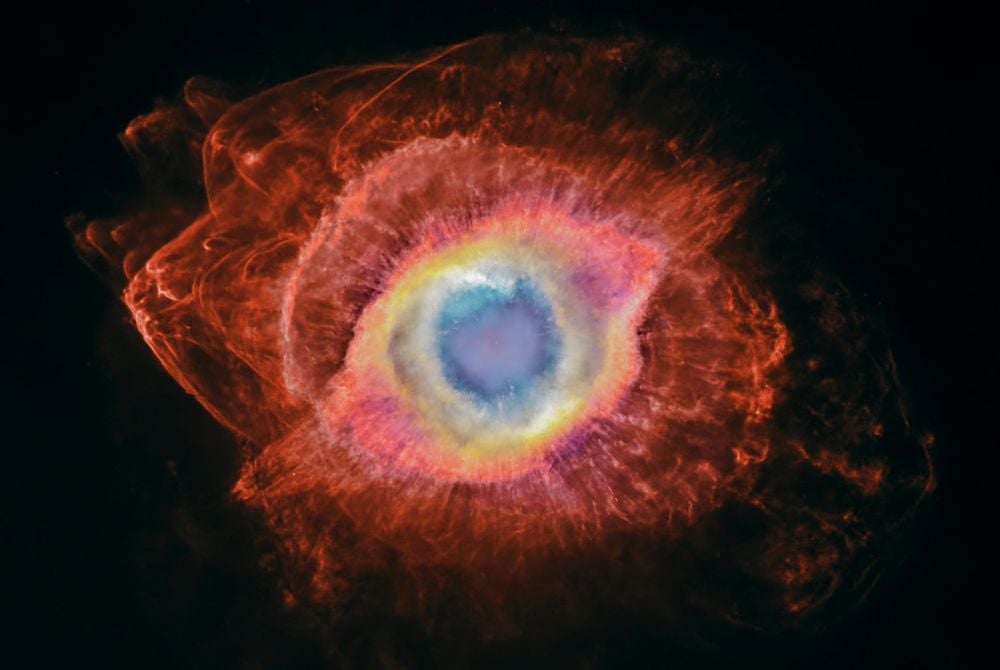
This is the Helix Nebula as captured by the MOTHRA telescope, combined with data from the Hubble Space Telescope and the Kitt Peak 4m telescope. New observations revealed more detail in the planetary nebula, showing where material cast-off from the star that created the nebula is being stripped down and recycled. Image Credit: Credit for the previous data: NASA, ESA, C. R. O’Dell (Vanderbilt University) and M. Meixner, P. McCullough and G. Bacon (Space Telescope Science Institute). Credit for the combination of MOTHRA, Hubble and Kitt Peak data: Andrew McCarthy

Astronomers used new MOTHRA telescope in Chile to image the famous Helix Nebula. They found 22 glowing shock waves where stellar debris from a dying star collided with interstellar gas. After colliding with gas, stellar fragments remain intact for just 10,000 years, the team estimates. The observations show how dying stars are recycled and return material to the interstellar medium to form new stars and planets.

Podden och tillhörande omslagsbild på den här sidan tillhör . Innehållet i podden är skapat av och inte av, eller tillsammans med, Poddtoppen.