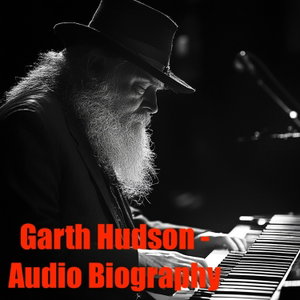
Garth Hudson was born Eric Hudson on August 2, 1937, in Windsor, Ontario, Canada. Raised in a musically inclined family, Hudson’s childhood was steeped in the rich traditions of classical and folk music. His mother, Olive, was a church organist and pianist who instilled in him a deep appreciation for the intricacies of music, while his father, Fred...
Visa
mer
Garth Hudson was born Eric Hudson on August 2, 1937, in Windsor, Ontario, Canada. Raised in a musically inclined family, Hudson’s childhood was steeped in the rich traditions of classical and folk music. His mother, Olive, was a church organist and pianist who instilled in him a deep appreciation for the intricacies of music, while his father, Fred, was a farm inspector who also played various instruments. This combination of structured musical education and organic familial creativity provided the fertile ground for Hudson’s burgeoning talent. From an early age, Hudson showed an innate curiosity about music, mastering the piano by the age of nine and quickly moving on to instruments like the accordion and saxophone. Hudson’s formal musical education began at the University of Western Ontario, where he studied music theory and performance. There, he delved into a wide range of genres, including classical, jazz, and rhythm and blues. This eclectic mix of influences would later define his style, as he found ways to merge these seemingly disparate elements into a cohesive sound. His classical training, in particular, gave him a strong technical foundation, but it was his love for improvisation and experimentation that truly set him apart. By the time he graduated, Hudson was not just a musician but a visionary who saw music as a boundless art form. Garth Hudson’s professional music career began in the early 1960s, a time when rock and roll was still evolving and defining its identity. His talent and reputation as a versatile musician soon brought him into the orbit of Ronnie Hawkins, a rockabilly star who had gained prominence for his high-energy performances. Hudson joined Hawkins’ backing band, The Hawks, as their organist and saxophonist, a move that marked a significant departure from his classical and jazz roots. This transition was not without challenges; for Hudson, rock and roll represented a new and less formal musical landscape, one that demanded innovation and adaptability. To justify his decision to his conservative, music-loving parents, Hudson negotiated an unusually high salary for his role in The Hawks and insisted on purchasing a Lowrey organ. This instrument, which was less commonly used in rock and roll than the popular Hammond organ, would become central to Hudson’s distinctive sound. The Lowrey’s capabilities for orchestral textures and tonal versatility allowed him to experiment with new approaches to arrangement and improvisation, creating a sound that would later define The Band’s identity. Hudson’s time with The Hawks was formative, not only for him but also for the group as a whole. While performing in clubs across Canada and the United States, The Hawks began to develop a reputation for their tight musicianship and dynamic performances. Hudson’s contributions were key to this success. His ability to seamlessly blend genres—infusing rock with elements of classical music, jazz, and rhythm and blues—gave the group a unique ed
This content was created in partnership and with the help of Artificial Intelligence AI.